Wednesday, November 12, 2008


I just found this image from Bruce Mau's book - powerlines collapsed under the weight of snow - completely beautiful and exciting, from a blog I stumbled across (called predesign)
and really wanted to share.

Monday, October 6, 2008

the re-surfacing of Teddy Cruz

A friend sent me this article on Artkrush, an interview with Teddy Cruz. I wrote about him last year when he was in town and still find his work fascinating; he experiments with and highlights the difference between the uber-planned, government/developer spaces (formal) and the socially determined (informal), and although he doesn't go for the jugular, hints at the corrosion of our democracy reflected in these regulated spaces and the inability of citizens to responsibly make these decisions in modern planning. The current paradigm strikes me as disturbingly contrary to the core values of democracy, and suggests that the inhabitants of the informal might be better in touch with true democracy than those of the formal. I also really enjoy his description of possible 'pixelization' of these mcmansions, possibly the first of many 'pixelizations' and a movement toward a high-resolution built world: designed not for magazines and elevations, but for experiencing up-close. I recommend you read it.

Monday, September 8, 2008

The Olmsteds and American urbanity, present and future

I never realized how much of America the Olmsteds shaped. I knew about the parks, of course. but then there were the parkways, campuses, and enormous subdivisions they planned, setting the tone for practically a century of urban and landscape planning.

The Frederick Law Olmsted National Historic Site and Arnold Arboretum hosted a panel discussion this past Sunday. Historian Charles Beveridge, UVA's Ethan Carr and Yale's Alexander Garvin and Dolores Hayden (who has authored some very interesting books) spoke specifically on the future of the Olmsted legacy, past and future. The family (Olmsted's sons have careers as prodigious as his own) defined the American city and suburb, with a little help from the City Beautiful movement, etc. - injecting a thirst for "natural" (though heavily engineered) green spaces into the public mind, a noble cause in the filthy cities of their time. In retrospect, they had a hand in our contemporary problem of sprawl.

I can't help but suspect there are solutions to sprawl in Olmsted ideas. His insistance that nature should be part of daily experience and that parks should be inclusive of all activity made me think of my daily commute. It also conflicts with the strict definition of American public space as leasure space, where the business of life is excluded. All public spaces in America, save a very few, are either strict leasure olmstead parks, or elaborate ornament for shopping or civic use. Rarely is there the richness of piazza life, were citizens interact in real-time.

The day left me dreaming of my urban streets filled not with sooty smog but the Olmstedian picturesque, my front door contuguous with all-purpose, useful parks. The convergence of these ideas - Olmsted, Shared Space, super-scale "machines as garens", is a hopeful sign, let's hope I get to be a part of it. ;)


Saturday, August 23, 2008

'Machine as the Garden' & the future of development

The Spring/Summer Harvard Design Magazine's main theme is non-formal cities, a hot topic and certainly a rich one - but the there is an an exciting counterpoint to this issue. Nathalie Beauvais, examines an exceptionally 'formal' planned city (well, campus extension): Harvard's Allston Campus. And her article is, mercifully, free. 

She asserts elegantly that the environmental "performance targets... can be read like source code... [and] will direct the forms of the built environment", facades will perform as permeable, reactive skins, and an entire ecosystem of solar panels, geothermal wells, bioswales and their compatriots will increase efficiency and protect the Charles river. The article explains much better than I can (links will remain valid until the issue is archived, I'm guessing).

Frequently the sheer scale of contemporary development seems overwhelming, homogeneous, a dehumanizing beast to attach stone veneer to or rally against at town meeting. What is so exciting about this article and the idea of the working landscape is that entire neighborhoods are being thought of as systems and structures; that scale is being used to enable harmonious diversity and increase sustainability rather than threaten these things.

Tuesday, August 19, 2008

Shared Spaces: harnessing the civility of people

A recent article in the Boston Globe Magazine suggests "Boston drivers are bad, but Boston pedestrians might be worse", presumably because they break traffic rules. But what if the rules are the problem? Because of the questionable habits of both parties, many streets in Boston exist in a de facto state of Shared Space, the slowly & steadily growing idea of Dutch planner Hans Monderman. It seems we are edging toward the recognition that the urban street is an altogether unique creature.

The idea is that all our fussing and stoplights and walklights and orchestration for safety is making our streets less safe. Drivers and pedestrians believe if they obey, everything will be fine. People stop thinking. Shared Space advocates the removal of curbs, signs, lights, etc. and letting people figure it out for themselves. Calling on common sense and cooperation, it harnesses the civility of people rather than letting it atrophy. Apparently it actually does reduce accidents, and reportedly reduces congestion due to increased efficiency.

The aesthetic value of clearing the clutter is promising as well, in addition to the promise of freeing urban life from the four foot strip of concrete mashed against building facades.

It's had success in the Dutch town of Drachten and in Germany.

The discussion brings the larger political implications of urban design tantalizingly close to the surface, but that's a post for another day.


"We're losing our capacity for socially responsible behaviour, ...The greater the number of prescriptions, the more people's sense of personal responsibility dwindles." [4]
- Hans Monderman


Tuesday, July 1, 2008

Living in parks

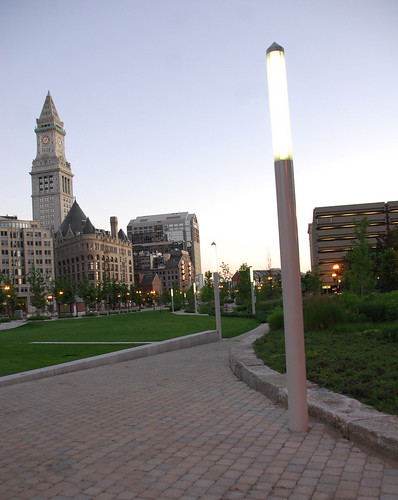
I've abandoned my blog and I'm sorry. Spring came, work got crazy, the academic season ended, and I've realized a phenomenal urban situation is evolving in our fine city.

I live in parks.

I wake up in the morning and weave through the narrow streets of my near medieval-density neighborhood, cross two lanes of (admittedly ornery) traffic and find my way down the lush greenery of the Greenway, through fountains and lawns for at least a third of my commute, then into urban fabric so dense it makes traffic seem ridiculous (it takes much longer to drive than to walk, and once you get there you can't park anywhere near by). My whole life is arranged around this park: work, gym, friends, groceries, farmer's market, favorite bars, the T, the highway tucked neatly underneath. Even trips to the bookstore, library, barber, and clothes are more than half spent in the Common, Garden, and Commonwealth Mall in that order. When I take the train to Cambridge I have found ways to do most of my walking next to lawns, as are my frequent destinations. I run on the esplanade, far from the road as possible. I'm not alone.

It's significant because it could make urban density more than palatable to the vast majority of people, reversing the wasteful cycle of sprawl and highway extension we are locked in.

The thing it's missing is contiguity: the ability to walk from a building directly into a park setting, to avoid almost entirely the damaging effects of particulate exhaust inhalation that will certainly surface in health care costs as generations age, dangers of traffic to children, and prevent the foolish hope that you are that very special person for whom the universe has reserved a parking spot directly in front of your destination.

This does exist in one quiet but enormously pregnant instance: the "corridor" park that runs between the Back Bay and South end, however no buildings open onto it, not one building admits it's proximity even though the park is lined with wealthy residents and their high-end retail establishments - what a precedent that could be. Oh well.

Wednesday, April 30, 2008

cyborg urbanism: Matthew Gandy, Geographer

Last week I went to go see what Geographer Matthew Gandy had to say about cyborg urbanism, mainly because it's a ridiculous title for a lecture, he is a Geographer, and it was beautiful out and I wanted to wander around Harvard Square.

His lecture delivered on the promised sci-fi kitsch from the moment he stood up at the podium, thirtyish with that skinny, wild-haired supernerd genius look and continued with references to awesome, campy sci-fi pop culture & movies (Metropolis sticks out in my mind).

He also delivered on substance, putting some meat on the study-but-inanimate bones of science fiction: he explained the term 'cyborg' and illustrated how it could be applied to the city, if we think of the city as an organism.

cyborg: Abbreviation of cybernetic organism.

cybornetics: the interdisciplinary study of the structure of complex systems, especially communication processes, control mechanisms and feedback principles. The essential goal of cybernetics is to understand and define the functions and processes of systems that have goals, and that participate in circular, causal chains that move from action to sensing to comparison with desired goal to action.

feedback and goals are the key to this idea. At first I was confused, he talked about the cyborg as an organism with both natural and artificial systems, and when we apply that to the city as an organism it falls a little flat - urbanity is natural (bodies) and artificial (streets, buildings). The novelty is in the idea of the digital enabling the city to pursue goals through feedback loops, presumably responding mechanically. This relates to a lot of the exciting work being done at the MIT Media Lab by folks like the Tangible Media Group and Ambient Intelligence Group. It also leaves the door open for material feedback systems that rely on the material's innate properties to create the desired mechanical reactions, rather than depending on delicate electrical systems.

I don't really know how this all relates to geography.