Showing posts with label Development. Show all posts

Saturday, August 23, 2008

'Machine as the Garden' & the future of development

The Spring/Summer Harvard Design Magazine's main theme is non-formal cities, a hot topic and certainly a rich one - but the there is an an exciting counterpoint to this issue. Nathalie Beauvais, examines an exceptionally 'formal' planned city (well, campus extension): Harvard's Allston Campus. And her article is, mercifully, free. 

She asserts elegantly that the environmental "performance targets... can be read like source code... [and] will direct the forms of the built environment", facades will perform as permeable, reactive skins, and an entire ecosystem of solar panels, geothermal wells, bioswales and their compatriots will increase efficiency and protect the Charles river. The article explains much better than I can (links will remain valid until the issue is archived, I'm guessing).

Frequently the sheer scale of contemporary development seems overwhelming, homogeneous, a dehumanizing beast to attach stone veneer to or rally against at town meeting. What is so exciting about this article and the idea of the working landscape is that entire neighborhoods are being thought of as systems and structures; that scale is being used to enable harmonious diversity and increase sustainability rather than threaten these things.

Tuesday, July 1, 2008

Living in parks

I've abandoned my blog and I'm sorry. Spring came, work got crazy, the academic season ended, and I've realized a phenomenal urban situation is evolving in our fine city.

I live in parks.

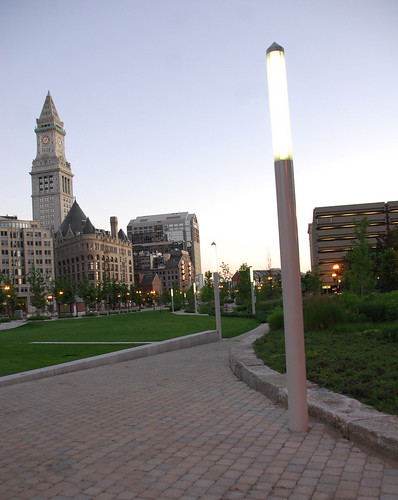
I wake up in the morning and weave through the narrow streets of my near medieval-density neighborhood, cross two lanes of (admittedly ornery) traffic and find my way down the lush greenery of the Greenway, through fountains and lawns for at least a third of my commute, then into urban fabric so dense it makes traffic seem ridiculous (it takes much longer to drive than to walk, and once you get there you can't park anywhere near by). My whole life is arranged around this park: work, gym, friends, groceries, farmer's market, favorite bars, the T, the highway tucked neatly underneath. Even trips to the bookstore, library, barber, and clothes are more than half spent in the Common, Garden, and Commonwealth Mall in that order. When I take the train to Cambridge I have found ways to do most of my walking next to lawns, as are my frequent destinations. I run on the esplanade, far from the road as possible. I'm not alone.

It's significant because it could make urban density more than palatable to the vast majority of people, reversing the wasteful cycle of sprawl and highway extension we are locked in.

The thing it's missing is contiguity: the ability to walk from a building directly into a park setting, to avoid almost entirely the damaging effects of particulate exhaust inhalation that will certainly surface in health care costs as generations age, dangers of traffic to children, and prevent the foolish hope that you are that very special person for whom the universe has reserved a parking spot directly in front of your destination.

This does exist in one quiet but enormously pregnant instance: the "corridor" park that runs between the Back Bay and South end, however no buildings open onto it, not one building admits it's proximity even though the park is lined with wealthy residents and their high-end retail establishments - what a precedent that could be. Oh well.

Monday, March 10, 2008

big talk about the formal/informal

There's a lot of talk about the divide between the "formal" (i.e., the planned, the controlled, the centralized) and the "informal" (messy, unplanned life), frequently the formal being associated with the first world, mcmansion, gated-community mentality (although the "first-world" status of gated communities is debatable) and the informal embodied in it's most pure form in Brazilian favellas and the dream worlds of Lebbus Woods.

I'm watching a fantastic video of a GSD lecture by Teddy Cruz (fantastic b/c, in addition to the content, I am in my sweatpants, eating dinner, and able to pause-and-rewind). He is giving a fascinating tour of the Tijuana/San Deigo border and the exchange that is going on there - the clash of the corporation-saturated southern California and the disorder of Mexican Tijuana. Drug dealer's tunnels through earth and buildings, entire houses picked up and transported south to make room for new ones, a double-headed Trojan Horse, built for transparency, straddling the boarder. I could go off on a dozen tangents.

He asserts, as many do, that the formal is ignorant of the informal, which is hard to deny. But isn't the formal just a reaction to the informal? Isn't it a clumsy, ham-fisted reaction to the informal, deriving it's existence from the very thing it seeks to squash?

Isn't it more than that, but actually a product of the failures of the informal?

look at the 'formal' systems around you - they seem to sink into the cracks in our "informal' society, where tight social circles fail and crime sneaks in, the formality of police force oozes in after it. Where private/civic organizations fail to provide comprehensive and open education, public education arises. Where the social contract fails to moderate land use, zoning arrives.

The strength of the organic, freely determined will always overwhelm the hollow and the formal, but can we guide and accelerate this to ensure it is as positive as possible?