
I never realized how much of America the Olmsteds shaped. I knew about the parks, of course. but then there were the parkways, campuses, and enormous subdivisions they planned, setting the tone for practically a century of urban and landscape planning.
The Frederick Law Olmsted National Historic Site and Arnold Arboretum hosted a panel discussion this past Sunday. Historian Charles Beveridge, UVA's Ethan Carr and Yale's Alexander Garvin and Dolores Hayden (who has authored some very interesting books) spoke specifically on the future of the Olmsted legacy, past and future. The family (Olmsted's sons have careers as prodigious as his own) defined the American city and suburb, with a little help from the City Beautiful movement, etc. - injecting a thirst for "natural" (though heavily engineered) green spaces into the public mind, a noble cause in the filthy cities of their time. In retrospect, they had a hand in our contemporary problem of sprawl.
I can't help but suspect there are solutions to sprawl in Olmsted ideas. His insistance that nature should be part of daily experience and that parks should be inclusive of all activity made me think of my daily commute. It also conflicts with the strict definition of American public space as leasure space, where the business of life is excluded. All public spaces in America, save a very few, are either strict leasure olmstead parks, or elaborate ornament for shopping or civic use. Rarely is there the richness of piazza life, were citizens interact in real-time.
The day left me dreaming of my urban streets filled not with sooty smog but the Olmstedian picturesque, my front door contuguous with all-purpose, useful parks. The convergence of these ideas - Olmsted, Shared Space, super-scale "machines as garens", is a hopeful sign, let's hope I get to be a part of it. ;)
Showing posts with label contiguity. Show all posts
Showing posts with label contiguity. Show all posts
Monday, September 8, 2008


Tuesday, August 19, 2008
Shared Spaces: harnessing the civility of people
A recent article in the Boston Globe Magazine suggests "Boston drivers are bad, but Boston pedestrians might be worse", presumably because they break traffic rules. But what if the rules are the problem? Because of the questionable habits of both parties, many streets in Boston exist in a de facto state of Shared Space, the slowly & steadily growing idea of Dutch planner Hans Monderman. It seems we are edging toward the recognition that the urban street is an altogether unique creature.
The idea is that all our fussing and stoplights and walklights and orchestration for safety is making our streets less safe. Drivers and pedestrians believe if they obey, everything will be fine. People stop thinking. Shared Space advocates the removal of curbs, signs, lights, etc. and letting people figure it out for themselves. Calling on common sense and cooperation, it harnesses the civility of people rather than letting it atrophy. Apparently it actually does reduce accidents, and reportedly reduces congestion due to increased efficiency.
The aesthetic value of clearing the clutter is promising as well, in addition to the promise of freeing urban life from the four foot strip of concrete mashed against building facades.
It's had success in the Dutch town of Drachten and in Germany.
The discussion brings the larger political implications of urban design tantalizingly close to the surface, but that's a post for another day.
The idea is that all our fussing and stoplights and walklights and orchestration for safety is making our streets less safe. Drivers and pedestrians believe if they obey, everything will be fine. People stop thinking. Shared Space advocates the removal of curbs, signs, lights, etc. and letting people figure it out for themselves. Calling on common sense and cooperation, it harnesses the civility of people rather than letting it atrophy. Apparently it actually does reduce accidents, and reportedly reduces congestion due to increased efficiency.
The aesthetic value of clearing the clutter is promising as well, in addition to the promise of freeing urban life from the four foot strip of concrete mashed against building facades.
It's had success in the Dutch town of Drachten and in Germany.
The discussion brings the larger political implications of urban design tantalizingly close to the surface, but that's a post for another day.
"We're losing our capacity for socially responsible behaviour, ...The greater the number of prescriptions, the more people's sense of personal responsibility dwindles." [4]
- Hans Monderman
- Hans Monderman
Tuesday, July 1, 2008
Living in parks
I've abandoned my blog and I'm sorry. Spring came, work got crazy, the academic season ended, and I've realized a phenomenal urban situation is evolving in our fine city.
I live in parks.
I wake up in the morning and weave through the narrow streets of my near medieval-density neighborhood, cross two lanes of (admittedly ornery) traffic and find my way down the lush greenery of the Greenway, through fountains and lawns for at least a third of my commute, then into urban fabric so dense it makes traffic seem ridiculous (it takes much longer to drive than to walk, and once you get there you can't park anywhere near by). My whole life is arranged around this park: work, gym, friends, groceries, farmer's market, favorite bars, the T, the highway tucked neatly underneath. Even trips to the bookstore, library, barber, and clothes are more than half spent in the Common, Garden, and Commonwealth Mall in that order. When I take the train to Cambridge I have found ways to do most of my walking next to lawns, as are my frequent destinations. I run on the esplanade, far from the road as possible. I'm not alone.
It's significant because it could make urban density more than palatable to the vast majority of people, reversing the wasteful cycle of sprawl and highway extension we are locked in.
The thing it's missing is contiguity: the ability to walk from a building directly into a park setting, to avoid almost entirely the damaging effects of particulate exhaust inhalation that will certainly surface in health care costs as generations age, dangers of traffic to children, and prevent the foolish hope that you are that very special person for whom the universe has reserved a parking spot directly in front of your destination.
This does exist in one quiet but enormously pregnant instance: the "corridor" park that runs between the Back Bay and South end, however no buildings open onto it, not one building admits it's proximity even though the park is lined with wealthy residents and their high-end retail establishments - what a precedent that could be. Oh well.
I live in parks.
I wake up in the morning and weave through the narrow streets of my near medieval-density neighborhood, cross two lanes of (admittedly ornery) traffic and find my way down the lush greenery of the Greenway, through fountains and lawns for at least a third of my commute, then into urban fabric so dense it makes traffic
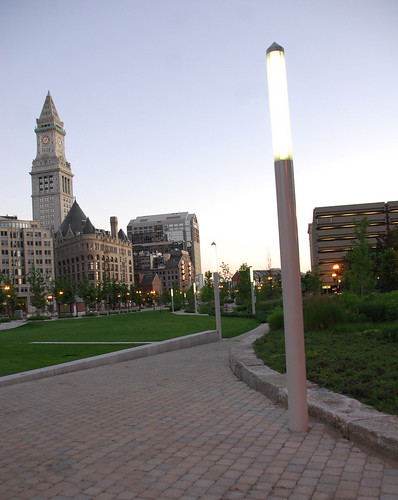 seem ridiculous (it takes much longer to drive than to walk, and once you get there you can't park anywhere near by). My whole life is arranged around this park: work, gym, friends, groceries, farmer's market, favorite bars, the T, the highway tucked neatly underneath. Even trips to the bookstore, library, barber, and clothes are more than half spent in the Common, Garden, and Commonwealth Mall in that order. When I take the train to Cambridge I have found ways to do most of my walking next to lawns, as are my frequent destinations. I run on the esplanade, far from the road as possible. I'm not alone.
It's significant because it could make urban density more than palatable to the vast majority of people, reversing the wasteful cycle of sprawl and highway extension we are locked in.
The thing it's missing is contiguity: the ability to walk from a building directly into a park setting, to avoid almost entirely the damaging effects of particulate exhaust inhalation that will certainly surface in health care costs as generations age, dangers of traffic to children, and prevent the foolish hope that you are that very special person for whom the universe has reserved a parking spot directly in front of your destination.
This does exist in one quiet but enormously pregnant instance: the "corridor" park that runs
 between the Back Bay and South end, however no buildings open onto it, not one building admits it's proximity even though the park is lined with wealthy residents and their high-end retail establishments - what a precedent that could be. Oh well.
Subscribe to:
Posts (Atom)